
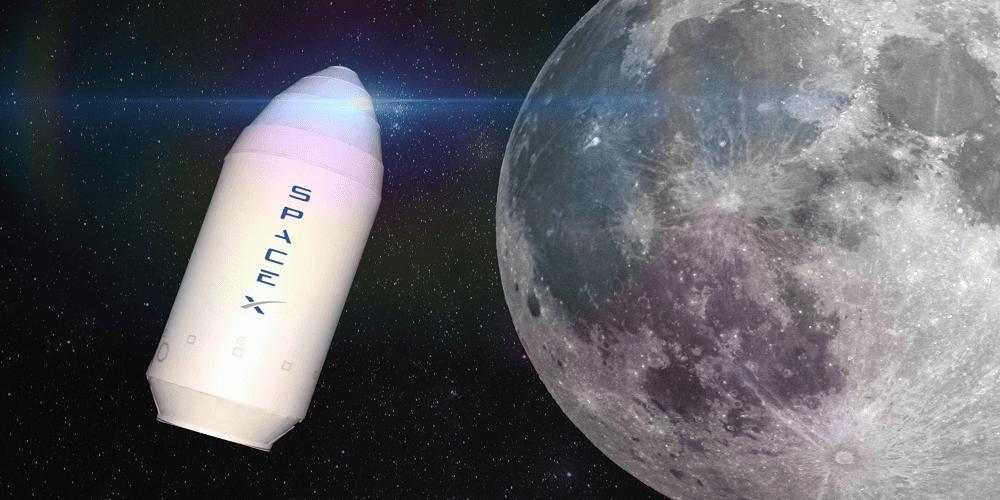
The phrase spacex rocket moon crash has attracted worldwide attention after astronomers discovered that a discarded SpaceX Falcon 9 upper stage is on a collision course with the Moon. The event is unusual because the rocket was not intentionally sent toward the lunar surface to create an impact. Instead, the spent stage remained in space after completing its original mission and gradually moved onto a trajectory that is expected to intersect with the Moon.
The impact is expected on August 5, 2026, near the Einstein crater on the Moon. Current calculations put the impact speed at roughly 2.4 kilometers per second, or about 5,400 miles per hour. Scientists expect the collision to create a fresh crater and throw lunar material outward from the impact site. NASA and other researchers are preparing to observe the event because an artificial impact can provide useful information about the Moon's surface and the behavior of lunar dust.
Although headlines may make the spacex rocket moon crash sound like a major accident involving an active SpaceX spacecraft, that is not what is happening. The object is a spent upper stage from a Falcon 9 launch that took place in January 2025. The rocket successfully delivered two lunar-bound spacecraft before the upper stage continued on its own trajectory.
What Is the SpaceX Rocket Moon Crash?
The spacex rocket moon crash refers to the expected collision between the Moon and a Falcon 9 upper stage identified as 2025-010D.
The rocket stage was part of a SpaceX Falcon 9 launch on January 15, 2025. That launch carried Firefly Aerospace's Blue Ghost Mission 1 and ispace's Hakuto-R Mission 2 toward the Moon. The mission was known as "Ghost Riders in the Sky."
Blue Ghost later achieved a successful lunar landing in March 2025. The ispace lander, however, did not complete its landing successfully. The Falcon 9 upper stage remained in space after delivering the payloads.
Unlike the reusable first stage of a Falcon 9, the upper stage was not designed to return to the launch site. Because the mission required a high-energy trajectory toward the Moon, the stage ended up in a large orbit around Earth that extended into the region influenced by the Moon.
Astronomers continued tracking the object. Over time, gravitational interactions changed its path. Eventually, calculations showed that the rocket stage would cross the Moon's orbit at approximately the same time as the Moon itself.
That is why the spacex rocket moon crash is happening now.
NASA says it is tracking the used Falcon 9 upper stage and plans to attempt observations using ground-based telescopes and space-based assets. Researchers are interested in recording the impact flash and studying the resulting ejecta plume.
When Will the SpaceX Rocket Hit the Moon?
The predicted impact date is August 5, 2026.
Recent scientific calculations place the collision at approximately 06:34 to 06:35 UTC. Because orbital predictions become more precise as additional observations are collected, the exact timing can change slightly.
The impact is expected to take place near the Einstein crater, close to the lunar limb as viewed from Earth. A recent scientific study estimates that the Falcon 9 upper stage will strike the lunar surface at around 2.43 kilometers per second. Another analysis estimates that the resulting crater could be roughly 40 meters across, although the final size will depend on the impact angle, mass distribution and surface conditions.
For people searching for the spacex rocket moon crash time, the key point is that the event is scheduled for the early hours of August 5 in UTC. That translates to different local times around the world.
The collision will happen on the Moon rather than anywhere near Earth, so there is no danger to people, aircraft or satellites around Earth from the impact itself.
Which SpaceX Rocket Is Going to Crash?
The object is the upper stage of a Falcon 9 rocket.
This is important because many people assume the story involves SpaceX's massive Starship vehicle. It does not.
The Falcon 9 is a two-stage orbital rocket. Its first stage provides most of the initial thrust and is normally recovered after launch. The second stage, also called the upper stage, continues the mission and delivers payloads into the required orbit or trajectory.
In the case connected with the spacex rocket moon crash, the upper stage was used to send lunar-bound spacecraft on their journey. Once its job was completed, it remained in space.
The object has been catalogued as 2025-010D. Researchers have tracked it for an extended period, allowing them to reconstruct its orbital history and connect it to the January 2025 Falcon 9 launch.
A recent scientific paper independently linked the object to the Ghost Riders in the Sky mission using orbital analysis. Researchers also examined its physical characteristics and found evidence consistent with spacecraft materials.
Why Didn't the Rocket Fall Back to Earth?
This is one of the most common questions about the spacex rocket moon crash.
Most people are familiar with rocket stages falling back into Earth's atmosphere. When a spacecraft or rocket stage enters the atmosphere at high speed, aerodynamic drag heats it dramatically and causes much of the object to burn up.
But not every mission leaves a rocket stage in an orbit that naturally brings it back to Earth.
A lunar mission requires significantly more energy than a typical low-Earth-orbit launch. The Falcon 9 upper stage involved in this event placed its payloads onto a trajectory that reached far beyond ordinary Earth orbit.
Once the stage was separated from the spacecraft, it did not have enough remaining fuel or a suitable trajectory to perform a controlled return to Earth.
It therefore continued moving through a large, elliptical orbit.
Gravity then became the key factor.
The Moon, Earth and Sun constantly influence objects moving through the solar system. A small change in velocity or position can eventually produce a major change in where an object travels months or years later.
In this case, repeated gravitational interactions altered the stage's path until it became possible for its orbit to intersect the Moon.
Was the SpaceX Rocket Sent Toward the Moon Intentionally?
No.
The spacex rocket moon crash is not a planned lunar impact experiment.
The Falcon 9 upper stage was used to deliver its payloads. Its eventual collision with the Moon was not the purpose of the launch.
This distinction is important because humans have deliberately crashed spacecraft and rocket stages into the Moon before.
NASA's LCROSS mission in 2009 intentionally sent a rocket upper stage into a permanently shadowed lunar crater. Scientists observed the resulting plume because they wanted to search for evidence of water and other materials.
The Apollo program also intentionally impacted discarded hardware on the Moon as part of scientific experiments. These impacts helped researchers study the Moon's interior by examining seismic signals.
The 2026 event is different because the Falcon 9 stage was not deliberately targeted at the lunar surface.
Where Will the Rocket Crash?
Current predictions place the spacex rocket moon crash near the Einstein crater, close to the boundary between areas of the Moon visible and difficult to observe from Earth.
Researchers have continued refining the expected impact location as they collect more observations.
A recent study predicts an impact between the Bell and Einstein crater regions. The exact location matters because it determines which telescopes and spacecraft may have an opportunity to observe the collision.
The Moon has no thick atmosphere, so the rocket stage will not experience the kind of atmospheric breakup that a similar object might experience during an Earth reentry.
Instead, the hardware will reach the surface at high velocity.
The collision should produce a flash, a crater and a cloud of lunar material called ejecta.
How Big Will the Crater Be?
Scientists cannot know the final crater dimensions with complete certainty before the collision.
However, recent modeling suggests that the impact could create a crater roughly 40 meters across.
The result depends on several factors, including the rocket stage's mass, speed, impact angle, orientation and the physical properties of the lunar soil.
The Moon's surface is covered by a layer of loose material called regolith. When a large object hits this material at high velocity, enormous amounts of dust and rock can be thrown away from the impact point.
A recent study estimated that the ejecta curtain could rise many kilometers above the surface, while a central ejecta spike could reach even greater heights. The study also examined whether the resulting plume could be observed from Earth-based and space-based instruments.
Can People See the SpaceX Rocket Moon Crash?
Possibly, but watching it with the naked eye is unlikely.
The spacex rocket moon crash will occur on a part of the lunar surface that may be observable by some astronomical facilities at the right time.
Scientists are particularly interested in telescopic observations because the collision could create a brief impact flash.
The challenge is timing.
The impact will be extremely short-lived, and the location on the Moon is close to the lunar limb. Atmospheric conditions, telescope size, daylight and the Moon's position in the sky will all influence whether an observer can record it.
NASA and researchers are coordinating observations using both ground-based and space-based instruments.
For amateur astronomers, a telescope may provide a better opportunity than simply looking at the Moon with the naked eye. However, seeing the actual flash is not guaranteed.
Is the SpaceX Rocket Moon Crash Dangerous?
No.
The spacex rocket moon crash does not represent a threat to Earth.
The rocket stage is heading toward the Moon, not toward Earth. Even though it is large by spacecraft standards, the impact will occur approximately 384,000 kilometers away.
There is also no realistic scenario in which the collision could break the Moon apart or significantly alter its orbit.
The Moon has been hit by asteroids and comets for billions of years. Its surface contains countless craters created by natural impacts.
A human-made rocket stage is tiny compared with the objects that have created major lunar craters throughout geological history.
The scientific importance of the event is therefore much greater than any physical danger.
Why Are Scientists Interested in the Crash?
The spacex rocket moon crash provides a rare opportunity to study a known artificial impact.
Scientists already understand many aspects of lunar impacts, but every controlled or well-documented collision can add useful information.
Researchers can potentially study the brightness of the impact flash, the shape and movement of the ejecta plume, the size of the resulting crater and the way lunar dust behaves after a high-speed collision.
If telescopes capture the event from different locations, researchers may also be able to compare observations and improve their understanding of impact physics.
The event could also help researchers develop better methods for identifying artificial objects traveling through cislunar space.
That is becoming increasingly important as more commercial companies and government agencies send spacecraft toward the Moon.
What Happened to the Blue Ghost Lander?
The Falcon 9 upper stage involved in the spacex rocket moon crash originally carried Firefly Aerospace's Blue Ghost Mission 1.
Blue Ghost successfully landed on the Moon on March 2, 2025, at Mare Crisium. NASA lists the mission as a successful lunar landing, and the mission became an important milestone for commercial lunar exploration.
This means the rocket stage's eventual lunar collision should not be confused with the failure of Blue Ghost.
The lander completed its own journey separately.
The Falcon 9 upper stage and the Blue Ghost lander followed different paths after separation. Blue Ghost used its own propulsion and navigation systems to reach the lunar surface, while the spent rocket stage continued along its post-launch trajectory.
That distinction explains why a successful lunar mission can still be connected to an unexpected rocket impact more than a year later.
What Happened to the Other Lunar Lander?
The January 2025 Falcon 9 launch also carried ispace's Hakuto-R Mission 2, known as Resilience.
The mission followed a different and longer route to the Moon. Eventually, however, contact with the spacecraft was lost shortly before its planned landing attempt.
The mission did not achieve the desired soft landing.
This illustrates how difficult lunar exploration remains. Reaching the Moon requires precise navigation, propulsion, communications and autonomous control.
NASA's current list of lunar missions includes several successful and unsuccessful commercial and government missions, demonstrating that lunar landing remains technically challenging.
Is This the First Rocket to Crash Into the Moon?
No.
Human-made objects have reached the lunar surface many times.
Some were deliberate impacts, while others were accidental.
NASA intentionally crashed the LCROSS mission's Centaur upper stage into the Moon in 2009 to investigate material in a permanently shadowed region.
There have also been accidental lunar impacts involving spacecraft and rocket stages from different countries.
The upcoming spacex rocket moon crash is particularly interesting because the object has been carefully tracked and its origin is known.
Researchers have been able to follow its trajectory and predict the collision in advance.
That makes the event a valuable opportunity for coordinated scientific observation.
What Does This Mean for Space Junk?
The spacex rocket moon crash has also revived discussions about space debris.
Space debris is usually associated with objects orbiting Earth, such as inactive satellites, rocket stages and fragments from collisions.
But as lunar exploration increases, another region is becoming important: cislunar space.
Cislunar space generally refers to the region around Earth and the Moon.
More missions will mean more spacecraft, transfer stages and other hardware traveling through this region.
Unlike low-Earth orbit, where atmospheric drag can eventually remove objects, cislunar space does not provide the same natural cleanup mechanism.
A discarded object can potentially remain in space for a long time.
The 2026 impact demonstrates why mission planners need to consider the long-term fate of rocket stages after they finish their primary jobs.
Could More Rocket Parts Hit the Moon?
It is possible.
That does not mean the Moon is about to become covered in rocket debris.
Space is enormous, and accurately predicting the trajectory of every object is difficult. Most rocket stages will never hit the Moon.
However, as the number of lunar missions grows, the number of objects traveling through cislunar space will also increase.
Scientists are therefore interested in better tracking systems and clearer disposal strategies.
The recent research surrounding 2025-010D specifically notes that the growing population of poorly tracked cislunar objects could make future identification and monitoring more important.
What Can We Learn From the SpaceX Rocket Moon Crash?
There are several lessons from the spacex rocket moon crash.
First, space missions do not end when a spacecraft completes its primary objective. Mission planners also need to think about where hardware goes afterward.
Second, orbital mechanics can produce unexpected outcomes over long periods. A rocket stage may appear harmless immediately after separation but later move into a trajectory that creates a close encounter with the Moon.
Third, tracking is extremely important.
Astronomers were able to identify the object, reconstruct its history and predict its lunar impact because observations were collected over time.
Finally, the event shows how quickly lunar exploration is expanding.
Commercial companies are now sending spacecraft to the Moon alongside government missions. As activity increases, responsible management of the space environment will become increasingly important.
Final Thoughts on the SpaceX Rocket Moon Crash
The spacex rocket moon crash is an unusual event, but it is not a disaster in the conventional sense.
A spent Falcon 9 upper stage from a January 2025 lunar launch is expected to collide with the Moon on August 5, 2026. The impact is expected near the Einstein crater at a speed of roughly 2.4 kilometers per second.
There is no threat to Earth.
Instead, scientists see the collision as an opportunity. Telescopes may capture the impact flash, while researchers can study the resulting crater and ejecta plume. The observations could improve understanding of lunar impact physics and help scientists prepare for future artificial impacts.
At the same time, the event serves as a reminder that space hardware does not simply disappear after a mission ends.
As humanity sends more spacecraft toward the Moon, Mars and other destinations, managing spent rocket stages and other hardware will become increasingly important.
The Moon has survived countless natural impacts throughout its history. This particular collision will barely change its surface on a planetary scale. But from a human perspective, the spacex rocket moon crash is significant because it demonstrates how today's space missions can create consequences that continue long after the original launch has ended.
FAQs About the SpaceX Rocket Moon Crash
What is the SpaceX rocket moon crash?
The spacex rocket moon crash is the expected collision of a spent Falcon 9 upper stage with the Moon on August 5, 2026. The stage was launched in January 2025 to carry lunar-bound spacecraft.
When will the SpaceX rocket hit the Moon?
Current predictions place the impact at approximately 06:34–06:35 UTC on August 5, 2026. The exact time can change slightly as astronomers refine the object's trajectory.
Where will the rocket crash?
The Falcon 9 upper stage is expected to strike near the Einstein crater region on the Moon, close to the lunar limb as viewed from Earth.
Is SpaceX intentionally crashing a rocket into the Moon?
No. The spacex rocket moon crash is an unplanned impact involving a spent upper stage that remained in a high, elongated orbit after completing its launch mission.
Is the rocket going to hit Earth?
No. The object is predicted to collide with the Moon. The event poses no direct danger to people on Earth.
Which rocket is crashing into the Moon?
It is a SpaceX Falcon 9 upper stage, catalogued as 2025-010D. It came from the January 15, 2025 launch that carried Firefly Aerospace's Blue Ghost Mission 1 and ispace's Hakuto-R Mission 2.
How fast will the rocket be traveling?
Scientists estimate an impact velocity of approximately 2.43 kilometers per second, equivalent to around 8,750 kilometers per hour or 5,400 miles per hour.
Will the crash create a crater?
Yes. Models indicate that the impact should create a new crater. One recent scientific analysis estimates a crater around 40 meters in diameter, although the final result will depend on the impact conditions.
Can I see the SpaceX rocket crash into the Moon?
It may be possible to detect the impact with suitable telescopes, but there is no guarantee that amateur observers will see it. Scientists are planning observations using ground-based and space-based instruments.
Was Blue Ghost involved in the crash?
No. Blue Ghost was the lunar lander carried by the same Falcon 9 launch. It successfully landed on the Moon in March 2025. The object expected to hit the Moon is the Falcon 9's spent upper stage, not Blue Ghost.
Why is this event scientifically important?
The spacex rocket moon crash gives researchers a rare chance to observe a known artificial impact. Studying the flash, crater and ejecta plume could improve knowledge of lunar impact processes and help scientists understand how human-made objects behave in cislunar space.
Has anything else crashed into the Moon?
Yes. Numerous spacecraft and rocket stages have reached the lunar surface, both intentionally and accidentally. NASA's LCROSS mission deliberately impacted the Moon in 2009, while other lunar missions have ended in unintended crashes.
Could this happen again?
Potentially. As lunar exploration increases, more rocket stages and spacecraft will travel through cislunar space. Better tracking and post-mission disposal planning can help reduce the possibility of future uncontrolled lunar impacts.
Does the SpaceX rocket moon crash threaten the Moon?
No meaningful planetary-scale threat exists. The Moon has experienced vastly larger natural impacts throughout its history. The event will create a relatively small new crater and provide an interesting scientific case study.
What is the biggest lesson from the SpaceX rocket moon crash?
The biggest lesson is that the end of a launch is not necessarily the end of a spacecraft's story. Rocket stages can remain in space for years and can follow complicated trajectories. As lunar missions become more common, responsible management and tracking of hardware beyond Earth orbit will become increasingly important.
Leave A Comment
0 Comment